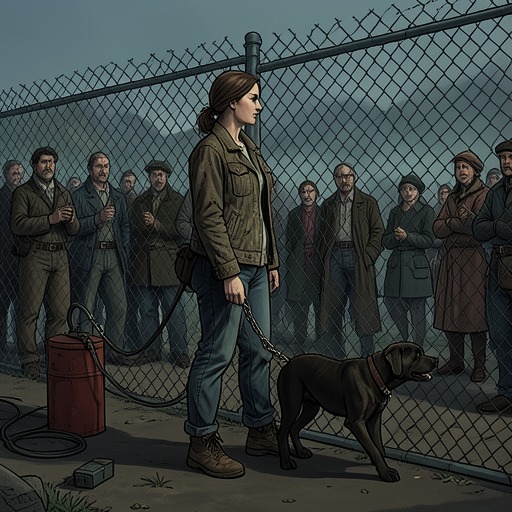
“Life doesn’t get better than this and it is still howling”
Hot Milk“Life doesn’t get better than this and it is still howling” is the culminating expression in a scene at Playa de los Muertos, where the first-person narrator recognizes Pablo’s dog alive on the beach. The line holds two facts together without resolving their contradiction: the dog is being cared for in a setting presented as idyllic, and it continues to howl. Its force comes from that persistence, not from an explanation of what the dog’s sound means.
The expression in context
The scene begins with the narrator lying on the beach and watching two girls swim in the clear sea with a dog. After they come ashore, they make a canopy from a green sarong stretched over sticks, give the animal water in a bowl, and stroke its fur. These details establish care through specific actions rather than declarations: the girls provide shade and water, and one attends to the dog’s coat. Against this careful attention, the howling persists.
The expression arrives only after the sound has been repeated and considered. First the dog howls; then the narration observes that it is being stroked but still howls; then comes the shorter formulation, “It is howling for nothing.” The longer line, “Life doesn’t get better than this and it is still howling,” extends that observation from the dog’s immediate situation to a broader statement about the limits of apparent well-being. The sequence makes the expression feel earned by the scene: it does not introduce an abstract idea from outside, but gives a name to the mismatch already audible within it.
Care and continuing distress
The line’s central contrast is between favorable conditions and an unchanged sound. The dog is not abandoned in this moment. The girls make shelter, offer water, and touch it gently; later, combing one girl’s wet hair seems to calm the animal as it drinks. Yet the dog’s howl remains the scene’s recurring fact. The expression does not cancel the kindness around the animal, but it refuses to treat kindness as proof that suffering has ended.
The shorter alias, “It is howling for nothing,” gives the sound an apparent absence of cause, while the longer expression places that apparent absence beside a claim that life cannot improve further. The resulting tension is not a diagnosis of the dog or a settled account of its distress. Rather, the narration records what can be seen and heard—the care, the water, the howl—and declines to make one fact erase another. “For nothing” intensifies the uncertainty: the sound is unmistakable, but the scene supplies no answer that would make it stop.
Recognition through the howl
The expression also belongs to a moment of recognition. The narrator identifies the animal as Pablo’s dog, describing it as an Alsatian, a German shepherd, and the diving-school dog, and says that its howl would be recognizable anywhere. The sound therefore does more than furnish atmosphere. It identifies a particular animal within the beach scene, and the narrator’s recognition turns the repeated howl into evidence of the dog’s presence and survival there.
That recognition changes the scale of the scene without changing its immediate details. What first appears to be a dog cared for by two strangers is also Pablo’s dog, alive and howling on Playa de los Muertos. The expression follows this realization closely: the animal’s present care does not make its prior identity irrelevant, nor does recognition quiet the sound. The line gathers the scene’s two strongest facts—the dog is there, and it is still howling—into a formulation that cannot be mistaken for uncomplicated happiness.
Repetition and significance
The repeated word “howling” supplies the expression’s structure. It moves from a sound heard in the scene to a condition that persists despite touch and water, and finally to the line’s wider, compressed paradox. Repetition prevents the reader from treating the howl as a passing detail. Even when the girls turn their attention elsewhere and lean against the dog, the sound remains the scene’s measure of what their care has not changed.
The expression’s significance lies in its refusal of a neat consoling ending. The beach, the shade, the bowl of water, and the girls’ attention might suggest that the animal has reached a better situation; the howl interrupts that inference. The line does not declare that care is useless or that improvement is impossible. It makes the narrower, more troubling point that conditions can look as good as they can get while distress continues. In this way, the phrase preserves both parts of the moment: tenderness toward the dog and the unresolved sound that tenderness cannot silence.